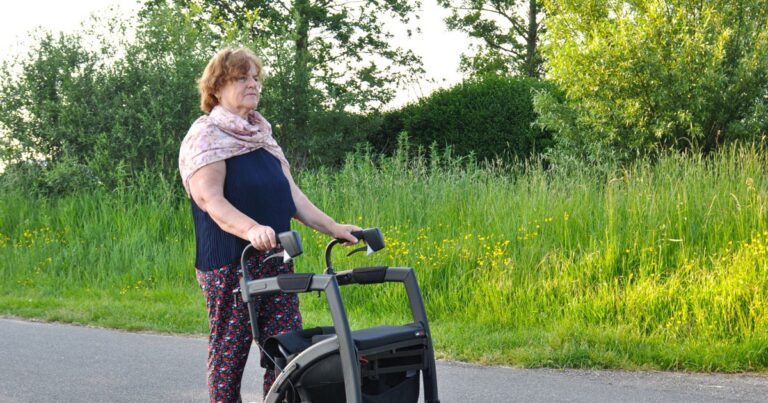

After a hip or knee replacement, most older adults go home the same day or within 1 to 2 days, and MedlinePlus advises having someone with them for 1 to 2 weeks. Light daily activities usually return in 3 to 6 weeks. A physical therapist runs the exercises; family or an aide helps with the bathroom, bathing, meals and walking.
This guide covers who does what in the first six weeks, how to ready a New York apartment, which symptoms are an emergency, and what Medicare pays. For the medical timeline, see our guides to hip replacement recovery and knee replacement recovery.
Who needs to be with Mom or Dad when they come home from joint replacement?
Someone should be there for the first 1 to 2 weeks, because the person will need help getting around the house, bathing and preparing meals. That is the advice in the MedlinePlus guides for hip replacement and knee replacement.
The American Academy of Orthopaedic Surgeons (AAOS) says to arrange this help before surgery. Before discharge, the hospital checks that the person can:
- get in and out of bed without help,
- use the bathroom,
- walk on a level floor with a walker, crutches or cane,
- go up and down two or three stairs,
- do the home exercises.
If they cannot, or nobody can help at home, AAOS says they may go to a rehab center or skilled nursing facility first. With same-day surgery, a parent can be home the same evening. If no one in the family can cover the first nights, plan post-surgery home care in NYC before the surgery date, not after discharge.
What happens in the first 6 weeks, and who helps at each stage?
Needs are highest in the first few days and drop as walking improves, and different people handle different parts of the job. Ranges are from AAOS OrthoInfo and MedlinePlus; the surgeon’s instructions come first.
| Stage | What usually happens | Help needed | Who provides it |
|---|---|---|---|
| Hospital | Same-day discharge or 1 to 2 days. Getting out of bed starts on the day of surgery | A ride home and someone at home that night | Family, or an aide who meets them at home |
| Days 1 to 3 at home | Pain, stiffness, short walks with a walker, blood thinners or other clot prevention as ordered | Help with every bathroom trip, getting up, meals, medication times, watching for warning signs, especially at night | Family or an aide, around the clock if possible. Home health nurse or therapist visits if ordered |
| Weeks 1 to 2 | Shower about 3 to 4 days after a hip, 5 to 6 days after a knee, if the surgeon agrees. No tub soaking. Stitches or staples out at about 10 to 14 days | Help in the shower, dressing, laundry, shopping, getting to the follow-up visit | Physical therapist, aide or family for daily tasks, a medical escort to appointments |
| Weeks 3 to 6 | Most light daily activities return in 3 to 6 weeks. Hip precautions usually last about 6 weeks. Many move from walker to cane | Less hands-on help. Company to outpatient therapy, heavier chores | Outpatient physical therapist, fewer aide hours, family |
| After 6 weeks | Exercises continue until strength returns. Full recovery takes several months | Usually occasional help only | Physical therapist and family |
The walker timeline varies. MedlinePlus says most people do not need a walker or crutches 2 to 4 weeks after a hip replacement, while after a knee replacement they may need one for up to 3 months. The AAOS knee exercise guide says a cane is often possible at about 2 to 3 weeks, once the person can walk and stand for more than 10 minutes without leaning on the walker. Ask the surgeon before switching. Blood thinners may be needed for 2 to 4 weeks, and compression stockings for about 6 weeks.
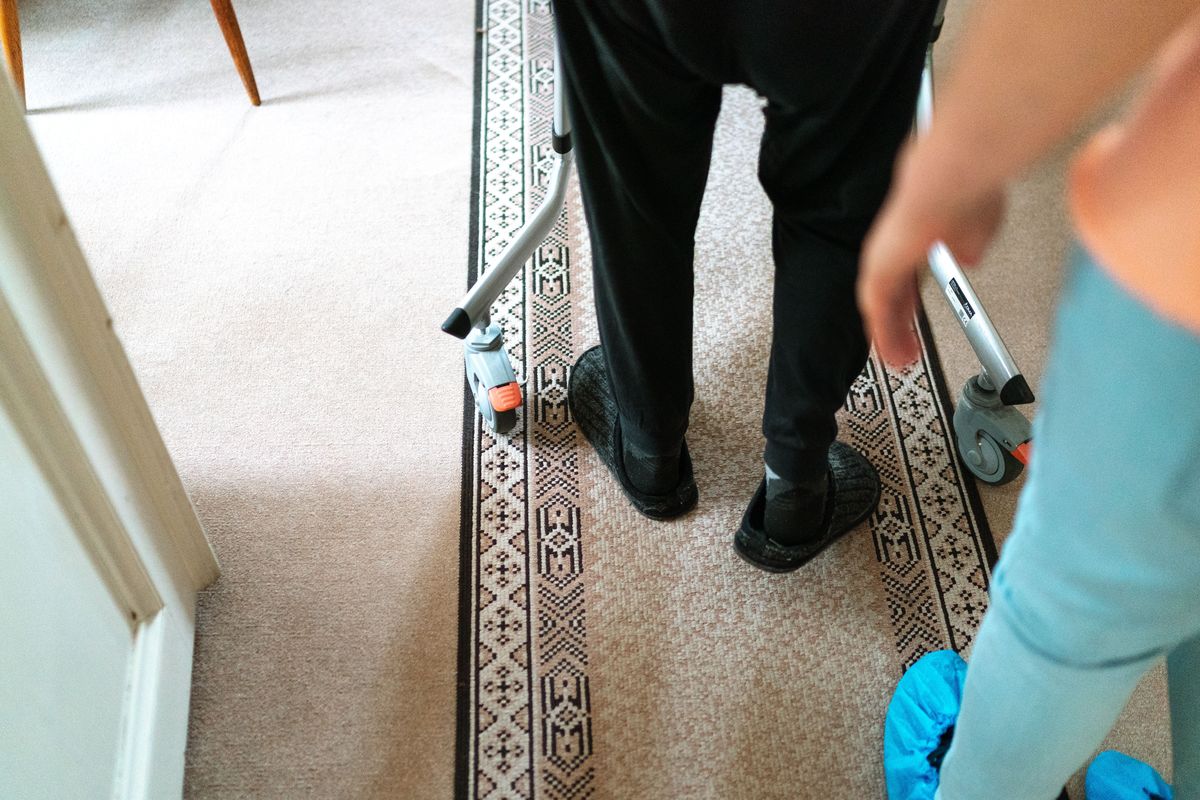
Is recovery at home different after a hip than after a knee?
Yes: after a hip, the main risk at home is moving the new joint into a position that can dislocate it; after a knee, the daily work is swelling and getting the knee to bend and straighten.
| Hip replacement | Knee replacement | |
|---|---|---|
| Positions to avoid | Depends on the surgical approach. Common rules: do not cross the legs, do not bend past 90 degrees, do not lean forward while sitting, do not reach to the floor. Usually about the first 6 weeks | Follow the knee precautions the surgeon and therapist give |
| Toilet and chairs | Raised toilet seat so knees stay lower than hips. Firm chair with arms, not low or soft | Raised toilet seat with arms if the toilet is low. Firm chair with arms, seat 18 to 20 inches high |
Sources: AAOS on activities after hip replacement and total knee replacement, and MedlinePlus on hip precautions at home. AAOS notes that serious complications such as joint infection occur in fewer than 2% of hip patients, and blood clots are among the most common complications.
How do you get a New York apartment ready before surgery?
Set things up so the person can sleep, wash and use the toilet without climbing stairs, and clear every path wide enough for a walker. These steps come from AAOS and MedlinePlus.
Stairs and walk-ups
- Tell the surgeon and discharge planner how many flights lead to the apartment. Discharge checks only two or three stairs.
- Make sure every staircase has a secure handrail.
- For a hip, MedlinePlus says to go up with the non-surgical leg first and down with the surgical leg first, holding the rail. Ask the physical therapist whether the same rule applies after a knee.
- In a duplex or house, sleep on the floor with the bathroom.
Bathroom and tub
- Grab bars in the tub or shower and by the toilet. MedlinePlus warns against using towel racks as grab bars.
- A shower chair or tub bench and a non-slip mat inside and outside the tub.
- A raised toilet seat, or a commode chair if the person cannot use a regular toilet.
- A handheld shower hose and long-handled sponge.
Bedroom and living room
- A bed low enough that the person’s feet touch the floor when sitting on the edge.
- A firm chair with two arms. Low sofas are hard to get out of.
- Remove throw rugs and loose cords, and add good lighting, including at night on the way to the bathroom.
- Phone, water, glasses and medicines within reach, plus a reacher, sock aid and a bag on the walker.
Medicare Part B covers a walker, cane or crutches when a doctor orders them for home use, and you pay 20% after the deductible. But Original Medicare generally does not pay for raised toilet seats, grab bars or bathtub seats, which CMS treats as convenience or self-help items. For low-cost options, see our guide to free medical equipment in New York.

Which symptoms mean call the surgeon, and which mean call 911?
Sudden shortness of breath or chest pain can mean a blood clot in the lungs, and MedlinePlus says to call 911 or go to the emergency room; most other warning signs mean calling the surgeon right away.
| What you notice | What it can mean | What to do |
|---|---|---|
| Sudden shortness of breath, chest pain that worsens with a deep breath, coughing up blood, fainting | Blood clot in the lungs (pulmonary embolism) | Call 911 |
| Calf pain, or one leg swollen, red or warmer than the other | Blood clot in the leg | Call the surgeon now |
| Fever (MedlinePlus: above 101°F; AAOS: persistent fever above 100°F), chills, redness, swelling or drainage at the incision | Infection | Call the surgeon now. Use the number the surgeon gave you |
| Bleeding that soaks the dressing and does not stop with pressure | Wound bleeding | Call the surgeon now |
| After a hip: the hip feels like it slipped out of place, sudden pain, cannot walk or bend it | Possible dislocation | Call the surgeon now |
| After a knee: foot or toes darker than normal or cool to the touch | Circulation problem | Call the surgeon now |
| On blood thinners: nosebleeds, blood in urine, dark or bloody stools | Bleeding from the medicine | Call the surgeon or prescribing doctor |
| A fall onto the surgical side, or pain the medicine does not control | Possible injury | Call the surgeon |
Sources: MedlinePlus on pulmonary embolus, the discharge guides above, and AAOS. Keep the surgeon’s after-hours number on the fridge. An aide can spot and report these signs; only a clinician decides what they mean.
What does Medicare pay for after a hip or knee replacement?
Medicare pays for home health visits, outpatient therapy, equipment and, after a qualifying hospital stay, short-term facility rehab, but not for 24-hour care or an aide who only helps with bathing and dressing.
| Type of help | Who pays | Rules and cost in 2026 |
|---|---|---|
| Home health: nurse, physical or occupational therapist, part-time aide | Medicare | Must be homebound (for example, cannot leave without a walker or another person), need part-time skilled care, and have a face-to-face visit and plan of care. $0 for covered services. An aide only alongside skilled nursing or therapy |
| Outpatient physical therapy | Medicare Part B | 20% of the approved amount after the $283 deductible. No yearly limit on medically necessary therapy |
| Rehab in a skilled nursing facility | Medicare Part A | Needs 3 days in a row as a hospital inpatient. Observation days and same-day surgery do not count. Days 1 to 20: $0 after the $1,736 deductible. Days 21 to 100: $217 a day |
| Walker, cane, crutches, commode chair, knee CPM machine | Medicare Part B | Doctor’s order, Medicare-enrolled supplier, you pay 20%. Commode only if confined to bed or room |
| Raised toilet seat, grab bars, bath seat | Usually you | Original Medicare generally does not cover them |
| Overnight or 24-hour aide, help with only bathing, dressing, meals | Private pay or Medicaid | Medicare does not pay for these |
Sources: Medicare.gov pages on home health services, skilled nursing facility care, physical therapy and walkers, the booklet Medicare and Home Health Care, and the CMS equipment reference list. Medicare Advantage plans have their own rules and may waive the 3-day rule, so call the plan.
The 3-day rule surprises many families. After outpatient surgery or an “observation” stay, Original Medicare will not pay for rehab in a facility. Ask before surgery whether your parent will be admitted as an inpatient.
Who stays at night, and what does that cost?
Because Medicare does not pay for overnight or 24-hour care at home, night help comes from family, a private-pay aide or Medicaid home care.
| Option | Cost | Good for | Watch out for |
|---|---|---|---|
| Family takes turns | No direct cost | Short recovery, relatives nearby | Exhaustion, missed work |
| Aide for the night shift | $35 an hour with ProLife (private pay) | The first nights, when bathroom trips are riskiest | Daytime still needs a plan |
| 24-hour care in shifts | Several aides, each $35 an hour, so 24 hours comes to $840 a day | Living alone, high fall risk, the first days | Step hours down as walking improves |
| Private duty nurse (RN or LPN) | $120 an hour with ProLife | Nursing tasks the surgeon orders | Not needed for most recoveries |
| Medicaid or MLTC home care | Paid by Medicaid if approved | People with Medicaid | Approval takes time; the plan sets hours |
| Short rehab facility stay | Medicare Part A if the 3-day rule is met | No safe help at home | Not after same-day surgery (Original Medicare) |
What can a home health aide do, and what can’t they do?
An aide helps with daily living and safety, but aides do not do physical therapy and do not do nursing tasks such as dressing changes or injections.
| A home health aide can | This needs a therapist, nurse or doctor |
|---|---|
| Stand by during transfers from bed, chair and toilet | Designing and teaching the exercise program (physical therapist) |
| Walk beside the person and the walker, at home and on the stairs | Deciding when to bear more weight or switch to a cane (surgeon, therapist) |
| Help with showering on a shower chair, dressing with a sock aid, toileting | Changing dressings and giving certain injections (nurse) |
| Cook, shop, do laundry, keep paths clear | Adjusting prescriptions (doctor) |
| Remind about medicine times and the exercises the therapist assigned | Deciding whether a symptom is serious (surgeon, 911) |
| Notice and report warning signs to the family and the agency nurse | Ordering equipment such as a walker (doctor) |
Medicare’s home health booklet lists changing dressings and certain injections as skilled nursing care. The therapy itself belongs to the physical therapist.
Need someone there the first night? How ProLife can help
ProLife can send a certified home health aide for home care after surgery, for a few hours or around the clock, to help with the bathroom, bathing, meals and walking. Private pay is $35 an hour; 24-hour care uses several aides in shifts, each at $35 an hour. Medicaid or MLTC home care is also possible. A private duty nurse (RN or LPN) is $120 an hour. For the follow-up or therapy visits, our medical escort starts at $200. A certified home health aide picks the person up, rides with them, stays at the appointment and brings them home. Call (718) 232-2777.
ProLife Home Care is a licensed home care agency serving all five New York City boroughs and Nassau County (New York State DOH licence #2572L001). We are not doctors or physical therapists, we do not diagnose, and we are not an ambulance service, an insurance company or HRA. We do not take part in CDPAP. For questions about care at home after surgery, call (718) 232-2777 or use our contact page.
Everything above was checked on 12 November 2026 against AAOS OrthoInfo, MedlinePlus, Medicare.gov and the CMS equipment reference list. This is general information, not medical advice. Follow your surgeon’s instructions.
Related guides
- Hip Replacement Recovery Week by Week at Home
- Knee Replacement Recovery Time: What to Expect at Home
- The Medicare home health benefit explained
- Fall prevention for seniors in NYC apartments
Frequently asked questions
How long does someone need to stay with a person after hip or knee replacement?
MedlinePlus advises having someone at home for the first 1 to 2 weeks after either surgery. AAOS says help with cooking, shopping, bathing and laundry may be needed for several weeks.
Does Medicare pay for a home health aide after knee or hip replacement?
Only part-time, and only if the person is homebound and also gets skilled nursing or therapy from a Medicare-certified home health agency. Medicare does not pay for 24-hour care.
Can a home health aide do physical therapy exercises with my parent?
No. A licensed physical therapist designs and runs the therapy. An aide can remind the person about the exercises the therapist assigned and stay close while they walk.
Can my parent go to a rehab facility after same-day knee or hip surgery?
Original Medicare pays for skilled nursing facility rehab only after 3 days in a row as a hospital inpatient, and observation days do not count. Some Medicare Advantage plans waive this rule, so ask the plan before surgery.
Does Medicare cover a raised toilet seat or shower chair?
Generally no. CMS lists raised toilet seats, grab bars and bathtub seats as non-covered. Medicare does cover a walker, cane or crutches with a doctor’s order.
How much does 24-hour care after surgery cost with ProLife?
Round-the-clock care uses several aides in shifts, each at $35 an hour, which comes to $840 for a full 24 hours. Medicaid or MLTC home care may also be an option for people who qualify.