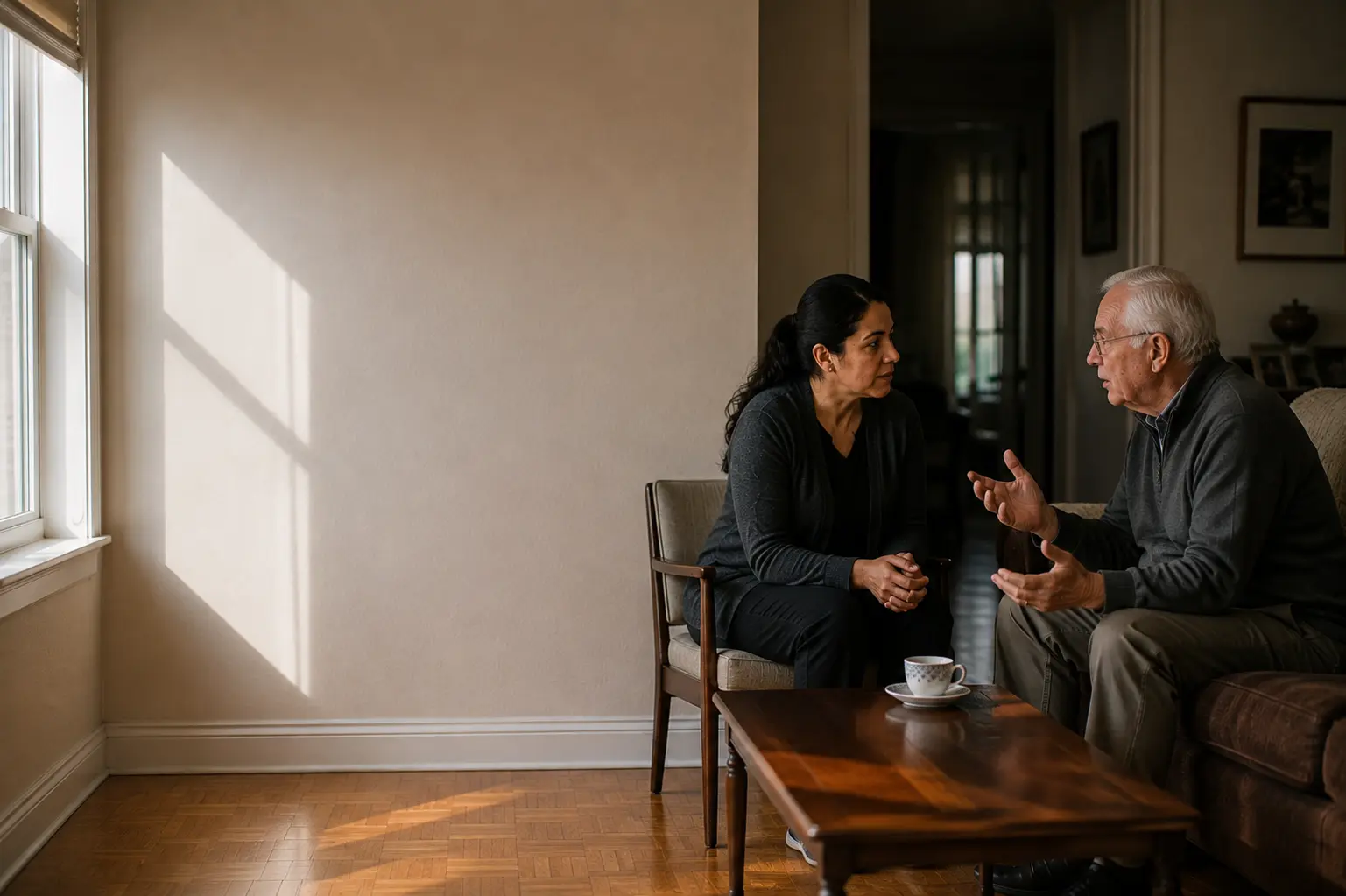
He Coughs Every Time He Drinks.
Everyone Says It's Just Age
Speech therapy at home in New York City
It is usually not age. A speech-language pathologist treats two things that get mistaken for one: speech and language after a stroke, and swallowing, which nobody thinks to mention on the first call and which is the reason a great many people end up back in the hospital. This page is about adults.
We will match a therapist near home.
A speech therapist works on talking and on swallowing.
Got it. Your request is with a coordinator, and we will call you back.
Your information is private and secure.
Swallowing problems: the part families miss
In home speech therapy covers two things, and this is the one families miss. Difficulty swallowing safely is called dysphagia, and it is treated by the same specialist who treats speech. Hardly anyone knows that, so it is commonly the thing families leave out when they call.

It gets missed because it looks like ageing. An older person who coughs at meals, eats slowly, or has gone off certain foods reads as someone who is simply getting older and fussier. The change is gradual, and there is never a moment obvious enough to raise with a doctor.
Signs worth mentioning to a doctor
- Coughing or throat-clearing while drinking, especially with thin liquids
- A wet or gurgling voice for a while after eating
- The feeling that food is sticking, or has stayed behind
- Meals taking much longer than they used to
- Quietly avoiding foods that were eaten before
- Weight loss with no obvious explanation
- Repeated chest infections or pneumonia
This is a list to bring to a physician, not a diagnosis. Any one of these can have several causes, and swallowing is assessed properly rather than guessed at.
The reason to act on it is where it leads. When food or liquid goes into the airway instead of the stomach it can cause aspiration pneumonia, and that is one of the more common reasons an older person who was managing at home ends up back in a hospital bed. The pneumonia gets treated and recorded; the swallowing problem underneath it frequently goes unnoticed, and the cycle repeats.
Treatment at home combines exercises for the muscles involved, changes to how food and drink are prepared, and adjustments to posture, pace and portion size at the table. Family members are taught what to watch for, because the person who notices a change is almost always whoever is sitting across from them at dinner.
One thing worth saying plainly, because most agencies leave it vague. New York law has included swallowing in the definition of speech-language pathology since 1997, and our operating certificate covers the service. The state also requires a clinician to practise only within their own competence, and dysphagia is a specialisation that not every speech-language pathologist holds. Some of ours do. So when swallowing is the reason for the referral, tell us on the first call and we will match the case to a therapist who works in it, rather than sending whoever is free. If we cannot staff it properly we will say so instead of starting and hoping.
Speech therapy after a stroke
A stroke can damage speech in three different ways, and they need different work. Families usually describe all three as "he can't talk properly," so the first visit goes on working out which one it actually is.
Aphasia is a problem with language itself rather than with the mouth. The word is there and will not come; or the wrong word arrives; or what you say arrives as noise. Intelligence is intact, which is what makes it so frustrating for everyone at the table. Therapy works on retrieving words, on rebuilding comprehension, and on practical workarounds such as gesture, writing and picture boards, so that communication continues while the language recovers.
Dysarthria is a problem with the muscles. The words are found correctly but come out slurred, quiet or slowed, because the lips, tongue or breath support are weakened. Work here is closer to physical training: strength and coordination of the speech muscles, pacing, breath support, and strategies for being understood while that improves.
Cognitive-communication difficulty is the least obvious of the three. Speech sounds normal, but attention drifts, the thread of a conversation is lost, instructions do not stick. Families often mistake it for early dementia, and it is treated quite differently.
What a session at home looks like
In-home speech therapy usually happens at the kitchen table, with the food and drink that are actually in the apartment. That is most of the advantage of doing this at home.

- Assessment first How speech is working, how swallowing is working, and what the day actually looks like, including what is being eaten and what has quietly been dropped.
- Swallowing exercises Targeted work on the muscles used to swallow, repeated between visits in short daily sets.
- Textures and consistencies Which foods are safe as they are, which need modifying, and whether liquids need thickening, worked out with the actual groceries in the kitchen.
- Positioning and pace How upright to sit, how long to stay upright afterwards, how large a mouthful, how long between them.
- Language and speech work Naming, comprehension, articulation and breath support, depending on which of the three problems is in play.
- Teaching the family How to give someone with aphasia time without finishing their sentences, and what a meal should and should not look like.
Speech therapy at home for adults
Search for this and most of what comes back is about children: early words, school support, home exercises for a four-year-old. Adult work is a different field. The starting point is not development but loss. Something that worked for seventy years has changed, and the person knows it, which brings a frustration that children's therapy simply does not involve.
Beyond stroke, the usual referrals are traumatic brain injury, Parkinson's disease, where the voice fades in volume long before it fails in clarity, dementia, where the goal is keeping communication going rather than restoring it, and recovery after prolonged intubation or throat surgery.
Working at home matters more here than people expect. Communication is a social act, and practising it in a clinic room with a stranger is not the same as practising it at the table where meals happen, with the family who will be on the other side of every conversation from now on.
Most of this work is with adults, usually after a stroke, and that is who this page describes. Age itself is not a filter: with a physician order a younger patient is not turned away. What runs on a different track are the state programmes for children, Early Intervention for the under-threes and school district services, which go through their own approvals rather than through a doctor’s order.
Therapy in the language your family actually speaks
Speech therapy has to be delivered in the language the patient actually speaks, which matters more here than in any other therapy. Physical therapy can largely be demonstrated; speech therapy cannot. Word-finding practice in a language someone learned at forty tells you very little about the language they dream in, and after a stroke it is common for a second language to be lost while the first one holds.

ProLife works in Russian, Spanish, Ukrainian, Chinese, Georgian, Bengali, Korean, Arabic, Haitian Creole, Urdu, Polish, and French, and for the Russian-speaking neighbourhoods of southern Brooklyn in particular this is not a convenience but a condition of the therapy working at all.
With speech therapy specifically the bar is higher than it is for care. An aide needs to communicate; a speech-language pathologist has to work inside the grammar and sound system of the language being treated, which means near-native command of it. So the honest answer is that the languages the agency covers and the languages we can run therapy in are not automatically the same list. Tell us which language the sessions need to be in when you call, and we will say straight away whether we have that therapist or whether you would be better served elsewhere.
How much speech therapy at home costs, and how often a therapist visits
For private pay we publish the price openly, which almost no agency in New York does.
Prices depend on the borough. Travel time across the city differs enough that one flat number would not be honest. Your address is confirmed on the call before anything is scheduled, and the rate is confirmed with it. Packages are available for physical therapy; for speech therapy we bill visit by visit.
Two ways it gets paid for
Paying privately is the fastest: no authorization to wait for, and scheduling starts when you decide. Or, if a certified home health agency is already following the case after a discharge, a therapist can come from ProLife under contract with them, and there the CHHA sets the terms and bills the family, not us. Why we do not bill Medicare directly, and how Medicaid and MLTC plans fit, is set out on who pays for therapy at home.
How often a therapist comes
Length varies more than with the other two therapies. Some people improve substantially within weeks; others continue over months, in blocks rather than continuously.
What decides the number of visits
The plan of care, written after the first assessment. With swallowing in particular, what happens at every meal between visits matters more than the sessions themselves, so the family is taught alongside the patient.
The therapist writes and runs that plan themselves, as an independently licensed clinician, and reports to the physician who ordered the therapy. Our nurse keeps the wider plan aligned, so an aide working in the same home knows what the therapist asked for at mealtimes.
Is it the speech, or the swallowing? Describe what you are seeing at meals and a nurse will tell you in one call whether this needs a speech therapist, and what it would cost.
When one therapy is not the whole picture
After a stroke all three are commonly ordered on the same sheet, and they are easier to run together than one after another.
All three therapies compared · Private duty nursing · Home health aide services
Where we go
Therapists visit homes across Brooklyn, Queens, Manhattan, the Bronx, Staten Island and Nassau County, under NY DOH License #2572L001. A first visit can usually be arranged from 24 hours after you ring, and what decides the date is the address rather than the borough. Coverage is not identical everywhere, and we would rather say so on the first call than have you wait and find out.
The full breakdown by borough, neighbourhood and office is on the therapy at home page.
- Service
- Speech-language pathology at home
- Where
- Patient's own home
- Counties served
- Kings, Queens, New York, Bronx, Richmond, Nassau
- Licence
- NY DOH NY DOH License #2572L001, licensed home care services agency (LHCSA)
- Physician order
- Required
- Typical frequency
- 1 to 3 visits a week
- Typical course
- 4 to 8 weeks, reassessed as goals are met
- Brooklyn and Queens
- $120 a visit
- Manhattan
- $170 a visit
- Bronx, Staten Island, Nassau
- $170 a visit
- Paid by
- Private pay, or under contract with a certified home health agency
- Not billed
- Medicare and Medicaid managed care, which require a CHHA licence
- Clinical oversight
- Registered nurse writes and reviews the plan of care
A nurse reads the order before a therapist rings your bell

Anna Klyauzova, RN, MSN, MPA
Anna reviews every plan of care before anyone is assigned. With speech therapy the part that needs settling early is swallowing: what consistency the food should be, who prepares it, and whether the aide in the home has been told. A recommendation that lives only in the therapist’s notes changes nothing at dinner, which is where it has to work.
She has nursed since 2011, at Jacobi Medical Center and then at Mount Sinai, where she ran an operating room team before co-founding ProLife in 2017. Her profile is public on LinkedIn, and the agency licence is public on NYS Health Profiles.
Families who called us first
4.9★ from 120 verified Google reviews across Brooklyn, Queens, Manhattan, the Bronx, Staten Island and Nassau County.
“Love this place! It is a very friendly, cozy environment. Irina the coordinator is very caring and friendly, she is always there when you need her.”
“I do not know what I would do without this agency. They gave me the best service I could ever imagine. Do not look anywhere else if you are looking for the best home care agency.”
“The staff there are very friendly and professional. You can always get help from them when you need. Strongly recommend to anyone looking for home care providers.”
These are reviews of the agency rather than of a particular therapist. All of them are public and can be read in full on our Google profile.
Things families ask us first
The therapy is not the hard part. Arranging it is.
Leave a number and a nurse calls you back to go through the case - what was ordered, what it will involve, and what it will cost. The call is free and commits you to nothing.
Rather call now? (718) 232-2777
We will match a therapist near home.
A speech therapist works on talking and on swallowing.
Got it. Your request is with a coordinator, and we will call you back.
Your information is private and secure.