She Stopped Using the Stairs, and
Nobody Noticed When
In-home physical therapy in New York City
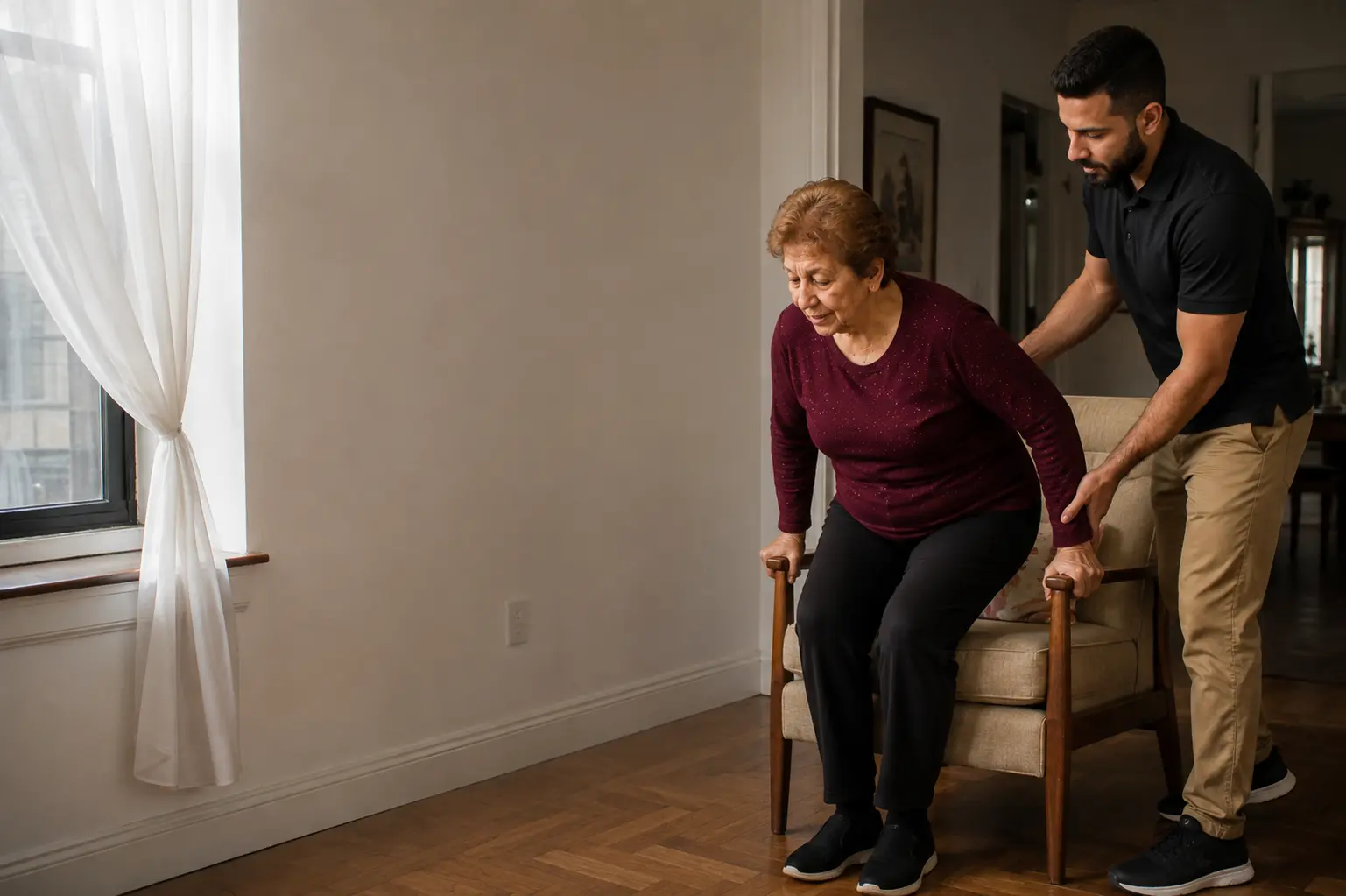
First it was the top floor. Then the shower, because stepping over the tub edge got frightening. In-home physical therapy works on exactly those movements, in the apartment where they have to happen, with a licensed therapist standing next to her.
Need a physical therapist at home?
Enter your ZIP and we check therapist availability near you.
Talk to a Nurse First
A registered nurse calls you back and goes through what was ordered and what it will take.
Your information is private and secure.
When a family needs physical therapy at home
Families ask for physical therapy at home after a hip or knee replacement, a stroke, a fall, a long hospital stay, or with Parkinson's disease. It usually starts with something you noticed, not something a doctor said out loud.
After a hip or knee replacement. The surgeon gives weight-bearing instructions and a follow-up date, and the hard part happens in between. Getting out of a bed that sits too low. The eleven steps to the front door. Moving from a walker to a cane without rushing it.
After a stroke. One side is weaker, balance has changed, and the route from the bedroom to the bathroom is suddenly a project. Progress here gets measured in transfers and in how far she can walk before she needs to sit.
After a fall. The injury is often the smaller half. The bigger half is that she has been moving less ever since, which weakens the legs, which raises the risk of the next fall. Breaking that loop is the whole point.
After a long hospital stay. Ten days in a bed costs an older person more strength than most families expect. Deconditioning is not a diagnosis anyone announces, but it is why she came home less able than she went in.
With Parkinson's disease. Freezing, shuffling, turning in a narrow hallway. The goal is holding ground rather than reversing anything, and it works better when the practice happens in the hallway in question.
When nothing happened at all. No fall, no surgery. Just less walking each month, more furniture-holding, more declined invitations. This is the one families wait longest on, and the one where starting early changes the most. We take any age. Most of home physical therapy is adults recovering from a replacement, a stroke or a fall, but a paediatric case is not turned away for being one.
What does a physical therapist do at home?
In home physical therapy is not a workout and not a massage. The first visit is an evaluation, and everything after it gets built from what that evaluation finds.
- Gait training Watching how she actually walks: stride, speed, what she holds on to, and correcting the parts that are storing up the next fall.
- Balance training Standing, turning, reaching, and recovering when something knocks her off centre. Practised where the rugs and the furniture actually are.
- Transfer training Bed to chair, chair to standing, on and off the toilet. The most frequent movements of the day and the ones most falls happen during.
- Strengthening and range of motion Targeted work on what has weakened or stiffened, kept inside the surgeon's weight-bearing limits where there is a repair to protect.
- The real stairs Eleven steps, a rail on one side, a turn at the top. A practice staircase in a clinic has none of those problems, which is why it is the easier one.
- Fitting the walker or cane Most assistive devices in New York apartments are the wrong height, and a walker set two inches too high is a fall waiting for a reason.
- Teaching the family How to steady someone without pulling on a repaired shoulder or an operated hip, and what to do if she starts to go down.
- Leaving work behind A short set of exercises for the days between visits, written down. What happens on those five days decides the outcome more than the two.
Physical therapy at home vs. a clinic
In-home physical therapy is as effective as a clinic for balance, walking, stairs and transfers, and a clinic wins where heavy equipment matters. Neither is worse; they suit different stages. What usually decides it is not the therapy but whether she can reliably get there twice a week for two months.

| At home | In a clinic | |
|---|---|---|
| Getting there | No trip. For someone whose balance is the problem, that removes the most dangerous part of the day. | A car or Access-A-Ride each way, plus the walk at both ends. |
| Where you practise | The actual stairs, tub and hallway she uses. | Standardised equipment that has to translate to home afterwards. |
| Family involvement | Whoever is home watches and is taught directly. | Usually a waiting room, and a summary afterwards. |
| Missed sessions | Rare. Nothing has to be arranged. | The most common reason a course of therapy ends early. |
| Equipment | What fits in an apartment. | Parallel bars, body-weight support, a full gym. A real advantage at the later stages. |
Physical therapy for seniors at home
In home health physical therapy for an older adult the goal is rarely to get back to how things were five years ago. It is to hold on to what makes independent living possible: getting to the bathroom at night, carrying a bag up from the lobby, standing long enough to cook. Small distances, and the ones that decide whether someone stays in their own apartment.
Fall prevention is most of the work. Roughly one in four older adults falls each year, and a first fall predicts the second. Balance and strength training lower that risk, and so does the unglamorous part: fitting the walker properly, working out which route to the bathroom is safest, noticing that the hallway light has been out for a month.
Fear is its own problem. After a fall people move less because they are afraid, which weakens the legs, which makes the next fall likelier. The loop tightens without anyone deciding anything, and it responds well to supervised practice in the place where the fear lives.
Deconditioning is the other one. A week or ten days in a hospital bed costs strength that took years to build. Started early, therapy recovers most of it. Started three months later, considerably less.
How much does physical therapy at home cost, and how long does it take?
For private pay we publish the price openly, which almost no agency in New York does.
Prices depend on the borough. Travel time across the city differs enough that one flat number would not be honest. Your address is confirmed on the call before anything is scheduled, and the rate is confirmed with it.
Two ways it gets paid for
Paying privately is the fastest: nothing to authorize, and scheduling starts when you decide. The other route is a certified home health agency already following the case after a discharge. There the CHHA sets the terms and bills the family, not us, and the prices above do not apply. Why we cannot bill Medicare directly, and how Medicaid and MLTC plans fit, is set out on who pays for therapy at home.
How long a course runs
After a joint replacement a course is often at the shorter end. After a stroke or with Parkinson’s it can run longer, or stop and return in blocks as goals change.
What decides the number of visits
Not a price list, but the plan of care: written after the first assessment and revised as things move. More visits are not automatically better. Two a week with real practice in between beats three a week with none, which is why the exercises left behind matter as much as the sessions, and why an aide who knows what the therapist asked for is worth more than an extra visit.
The therapist writes and runs that plan themselves, as a licensed clinician, and reports progress back to the physician who wrote the order. Our nurse keeps the wider plan aligned, so the aide and the therapist are not working from two different sets of instructions.
Not sure physical therapy is what was ordered? Read out what the discharge sheet says and a nurse will tell you in one call which therapy it is, and what it would cost.
When one therapy is not the whole picture
Physical therapy is about moving, occupational therapy is about doing everyday tasks, and speech therapy covers talking and swallowing. Two often sit alongside this one, especially after a stroke, and they are commonly ordered on the same sheet.
All three therapies compared · Home health aide services · Private duty nursing
Physical therapy at home across New York City and Nassau County
Physical therapists visit homes across Brooklyn, Queens, Manhattan, the Bronx, Staten Island and Nassau County, under NY DOH License #2572L001. Walk-ups are not an obstacle: the stairs are usually part of what the therapist is working on. Coverage is not identical everywhere, and a first visit can usually be arranged from 24 hours after you ring. What decides the date is the address rather than the borough, so give us the cross streets and we will name a realistic day.
All 48 neighborhoods
All 47 neighborhoods
All 32 neighborhoods
All 43 neighborhoods
All 37 neighborhoods
All 39 neighborhoods
- Service
- Physical therapy at home
- Where
- Patient's own home
- Counties served
- Kings, Queens, New York, Bronx, Richmond, Nassau
- Licence
- NY DOH License #2572L001, licensed home care services agency (LHCSA)
- Physician order
- Required
- Typical frequency
- 2 to 3 visits a week
- Typical course
- 4 to 8 weeks, reassessed as goals are met
- Brooklyn and Queens
- $70 a visit · 5 visits $300 · 10 visits $500
- Manhattan
- $180 a home visit
- Bronx, Staten Island, Nassau
- $170 a home visit
- Also paid by
- Contract with a certified home health agency, billed at that agency’s rate
- First visit
- From 24 hours after the call
- Not billed
- Medicare and Medicaid managed care, which require a CHHA licence
- Clinical oversight
- Registered nurse writes and reviews the plan of care
A nurse reads the order before a therapist rings your bell

Anna Klyauzova, RN, MSN, MPA
Anna reviews every plan of care before anyone is assigned. With physical therapy the question is usually not whether it is needed but how it fits around the rest of the week: which days the aide is already there, what the surgeon allowed in terms of weight bearing, and who is in the apartment on the days nobody comes. That is what she settles with the referring physician before scheduling starts.
She has nursed since 2011, at Jacobi Medical Center and then at Mount Sinai, where she ran an operating room team before co-founding ProLife in 2017. Her profile is public on LinkedIn, and the agency licence is public on NYS Health Profiles.
Families who called us first
4.9★ from 120 verified Google reviews across Brooklyn, Queens, Manhattan, the Bronx, Staten Island and Nassau County.
“Very friendly and polite staff. And most importantly they are professionals in their field. I have been using their services for several months, I like everything. I recommend this agency.”
“Very much respect and trust this agency. I was very lucky to have been recommended to them. These guys make my job easier and help me take care of my relatives.”
“I have never experienced care and professionalism like this agency before. Staff are very understanding, caring, and helpful.”
These are reviews of the agency rather than of a particular therapist. All of them are public and can be read in full on our Google profile.
Things families ask us first
The therapy is not the hard part. Arranging it is.
Leave a number and a nurse calls you back to go through the case - what was ordered, what it will involve, and what it will cost. The call is free and commits you to nothing.
Rather call now? (718) 232-2777