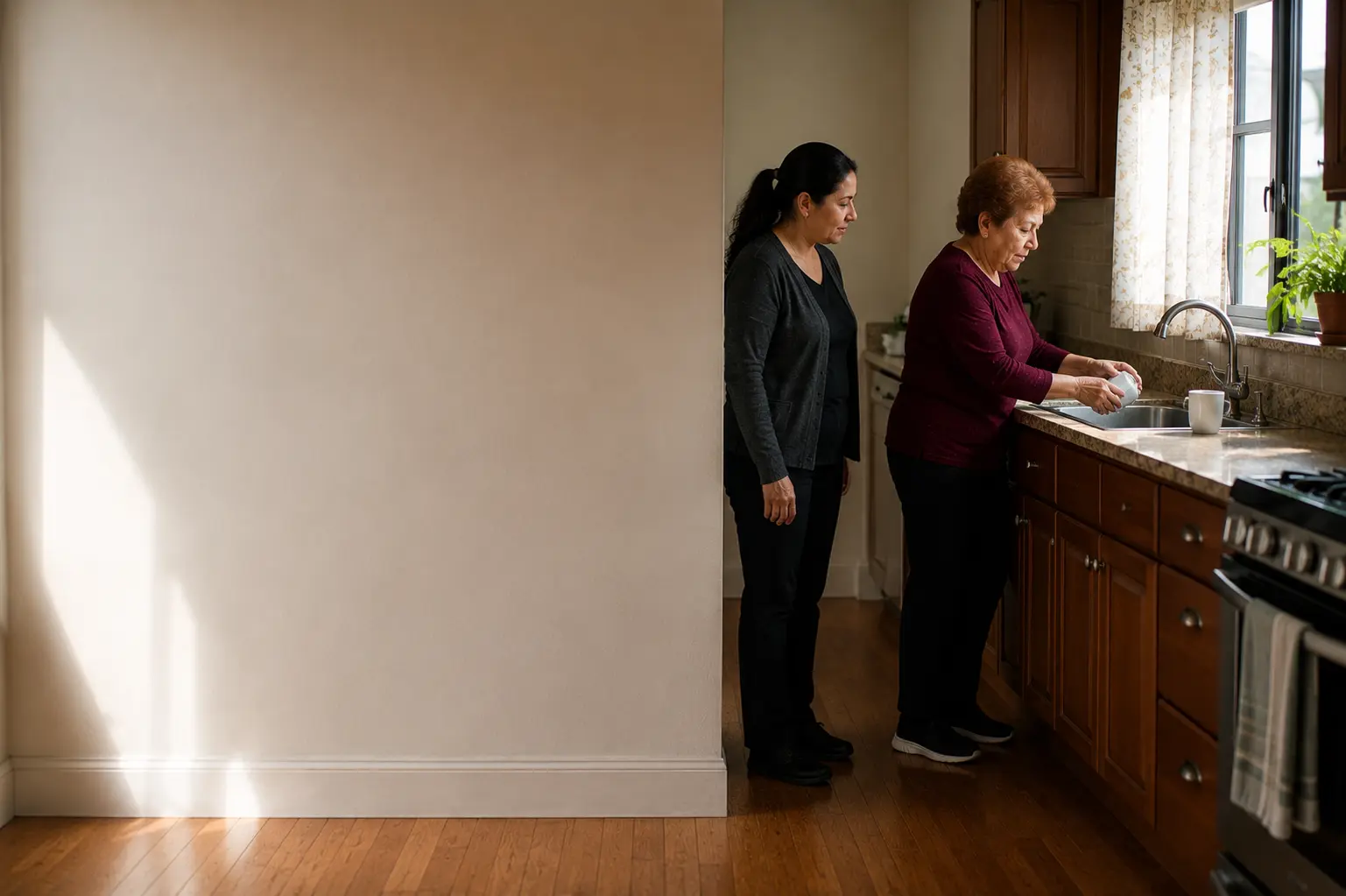
She Can Walk to the Kitchen.
She Just Can't Make Lunch Anymore
In-home occupational therapy in New York City
The legs are fine. What broke is the sequence: reaching the pan, holding the jar, standing long enough to finish. Occupational therapy at home works on those tasks and changes the apartment where the apartment is the problem.
We will match a therapist near home.
A therapist shows what to change in the apartment.
Got it. Your request is with a coordinator, and we will call you back.
Your information is private and secure.
The difference between occupational therapy and physical therapy
Everyone asks this first, and the answer fits in one line: physical therapy is about moving; occupational therapy is about doing.
One works on the body - strength, balance, walking. The other works on the task: whether she can actually get dressed, wash, and put a meal together at the end of it. Someone can regain the strength to stand at a counter and still be unable to cook, because cooking is a sequence of steps, reaches and grips rather than a single movement.
| Occupational therapy | Physical therapy | |
|---|---|---|
| The goal | Doing the day independently | Moving safely and with strength |
| A typical session | Practising a real task, then adjusting the method or the equipment | Exercise, walking practice, balance work, transfers |
| An example | Getting dressed one-handed after a stroke; a shower chair and a long-handled sponge | Walking to the corner with a cane instead of a walker |
| Looks at the apartment | Yes: layout, heights, lighting, storage, bathroom | Mainly the routes: stairs, hallways, the way to the bathroom |
| When you need both | After a stroke, a fall, or a long hospital stay, which is most of the time. They are usually ordered together, not one after the other. |
What an occupational therapist changes in the apartment
In home occupational therapy is partly teaching a new method. A lot of it is moving the apartment closer to the person, so less has to be relearned in the first place.

- Grab bars, in the right places Beside the toilet and inside the tub, at the height that suits this person, not wherever the wall happened to be convenient. The therapist marks the spot and the height; putting them up is a handyman job, not a therapy one.
- A shower chair and a hand-held shower head Standing through a wash is where a great many bathroom falls happen. Sitting through it removes the risk entirely.
- Seat and bed heights A raised toilet seat, a firmer chair, a bed at the height where standing up does not require a running start.
- The kitchen, rearranged Everyday plates and pans down to counter height. Nobody should be on a step stool for the things they use twice a day.
- Adaptive equipment A long-handled shoehorn, a sock aid, a reacher, a jar opener, weighted cutlery. Small objects that hand back a whole task.
- Rugs, cords and lighting The throw rug in the hallway and the lamp nobody can reach from the bed cause more injuries than most people would credit.
- New methods for old tasks Dressing with one working hand, washing while seated, cooking in stages instead of all at once.
- Energy conservation Where to sit, when to rest, which order to do things in, so the day does not run out before the important parts of it.
The home safety evaluation
A home safety evaluation is a room-by-room walk through the apartment looking for what causes falls and injuries. Lighting, rugs and cords, the bathroom layout, seat and bed heights, what is stored out of reach, how wide the path is between the bed and the bathroom at three in the morning. It usually takes under an hour.

What you get at the end is a written list, ordered by how much difference each item makes rather than by how easy it is. Some of it costs nothing: move the rug, change the bulb, clear the hallway. Some of it is a purchase of twenty or thirty dollars. A small part needs a handyman. To be clear about the division of labour: we assess and recommend, and the family arranges the installing. That is worth knowing in advance, because a list of changes is only useful if somebody is going to make them.
It is worth doing before a fall rather than after one, and it is the single most useful hour of occupational therapy for a family that is mainly worried rather than dealing with a specific injury.
When families need occupational therapy
Occupational therapy at home is ordered after a stroke, with dementia, after a fracture of the shoulder or wrist, with arthritis and with failing vision.
After a stroke. One side is weaker or not cooperating, and every two-handed task in the day needs rebuilding: buttons, jars, washing, cutting food. This is the largest single reason people are referred.
With dementia. The work shifts from teaching to simplifying: fewer choices, clothes laid out in order, labels where they help, hazards removed. A good deal of it is coaching whoever is caring, since the environment does more of the work than instruction can.
After a fracture of the shoulder, wrist or arm. Walking is fine. Dressing, washing hair and opening containers are not, and a sling changes the method for every one of them.
With arthritis. Joint protection, grip aids, and ways to do the same task with less strain, so that it stays possible for longer.
With failing vision. Contrast, lighting, labelling and consistent placement, so she can find her way by memory and touch when sight is no longer doing all the work.
When the concern is general. No single event, just a growing sense that things are not being managed as well as they were. That is a legitimate reason to ask, and it is usually where a home safety evaluation starts. Age is not a filter: most of this work is with older adults, but with a physician order a younger patient or a child is not turned away for being one. What runs differently are the state programmes for children, Early Intervention and school district services, which go through their own approvals rather than through us.
Occupational therapy after a stroke
Recovery after a stroke gets described in terms of walking, because walking is visible. But the things that decide whether someone lives independently are smaller: fastening a button, holding a cup without spilling, getting a shirt over a weak arm, managing in the bathroom without another person present.

An occupational therapist works on the affected side where it can recover, and teaches compensations where it cannot: one-handed dressing techniques, adaptive equipment, sequencing a task so fatigue does not end it halfway. Where the stroke affected attention or planning as much as movement, the work also covers remembering the steps and keeping to them.
Speech and swallowing are handled by a different specialist, and after a stroke all three are frequently ordered together. See speech and swallowing therapy.
How much occupational therapy at home costs, and how often a therapist visits
For private pay we publish the price openly, which almost no agency in New York does.
Prices depend on the borough. Travel time across the city differs enough that one flat number would not be honest. Your address is confirmed on the call before anything is scheduled, and the rate is confirmed with it. Packages are available for physical therapy; for occupational therapy we bill visit by visit.
Two ways it gets paid for
Paying privately is the fastest: nothing to authorize, and scheduling starts when you decide. The other route is a certified home health agency already following the case, and there the CHHA sets the terms and bills the family rather than us. Why we cannot bill Medicare directly, and how Medicaid and MLTC plans fit, is set out on who pays for therapy at home.
How often a therapist comes
A home safety evaluation on its own can be a single visit. After a stroke the course usually runs longer and overlaps with physical therapy.
What decides the number of visits
The plan of care, written after the first assessment and revised as things change. Much of the value sits in what happens between visits: a grab bar in the right place works every day, and a method learned once has to be used without the therapist standing there.
Not sure this is occupational therapy? Describe what she has stopped doing around the apartment and a nurse will tell you in one call which therapy fits, and what it would cost.
When one therapy is not the whole picture
Occupational therapy is about doing everyday tasks, physical therapy is about moving, and speech therapy covers talking and swallowing. Two usually sit alongside this one, and after a stroke all three tend to arrive on the same order sheet.
All three therapies compared · Alzheimer's and dementia care · Home health aide services
Occupational therapy at home across New York City and Nassau County
Occupational therapists visit homes across Brooklyn, Queens, Manhattan, the Bronx, Staten Island and Nassau County, under NY DOH License #2572L001. Because much of the work is about the apartment itself, the first visit is where the therapist sees the real bathroom and the real kitchen. A first visit can usually be arranged from 24 hours after you ring, and the address decides the date more than the borough does.
All 48 neighborhoods
All 47 neighborhoods
All 32 neighborhoods
All 43 neighborhoods
All 37 neighborhoods
All 39 neighborhoods
- Service
- Occupational therapy at home
- Where
- Patient's own home
- Counties served
- Kings, Queens, New York, Bronx, Richmond, Nassau
- Licence
- NY DOH License #2572L001, licensed home care services agency (LHCSA)
- Physician order
- Required
- Typical frequency
- 1 to 3 visits a week
- Typical course
- 4 to 8 weeks, reassessed as goals are met
- Brooklyn and Queens
- $120 a visit
- Manhattan
- $170 a visit
- Bronx, Staten Island, Nassau
- $170 a visit
- Paid by
- Private pay, or under contract with a certified home health agency
- Not billed
- Medicare and Medicaid managed care, which require a CHHA licence
- Clinical oversight
- Registered nurse writes and reviews the plan of care
A nurse reads the order before a therapist rings your bell

Anna Klyauzova, RN, MSN, MPA
Anna reviews every plan of care before anyone is assigned. Occupational therapy produces a list of changes to the apartment, and the list is where cases stall: someone has to fit the grab bar, someone has to keep using the shower chair, and the aide who comes on other days has to know what was agreed. That is the part she settles before scheduling starts.
She has nursed since 2011, at Jacobi Medical Center and then at Mount Sinai, where she ran an operating room team before co-founding ProLife in 2017. Her profile is public on LinkedIn, and the agency licence is public on NYS Health Profiles.
Families who called us first
4.9★ from 120 verified Google reviews across Brooklyn, Queens, Manhattan, the Bronx, Staten Island and Nassau County.
“Very good place. The staff are very friendly. The reception and care is very reliable. I recommend this place to everyone.”
“The staff is very nice and knowledgeable. Irene is always super helpful with all my questions and concerns. Strongly recommended!”
“The best home care agency you can find in New York. Very caring, professional, and knowledgeable staff. Helped me solve all the problems I had. Highly recommended!”
These are reviews of the agency rather than of a particular therapist. All of them are public and can be read in full on our Google profile.
Things families ask us first
The therapy is not the hard part. Arranging it is.
Leave a number and a nurse calls you back to go through the case - what was ordered, what it will involve, and what it will cost. The call is free and commits you to nothing.
Rather call now? (718) 232-2777
We will match a therapist near home.
A therapist shows what to change in the apartment.
Got it. Your request is with a coordinator, and we will call you back.
Your information is private and secure.